Family Support Worker Course
 63 Students


 14-Day Money-Back Guarantee
-
1 Year Access
 -
Intermediate Skill Level
 -
Course Certificate Certificate
 -
52 Units
Units -
2 Quizzes
 -
13 hours, 5 minutes Duration


Description:
Family support workers are social services professionals who provide assistance and guidance to children and families in need. They work in settings such as foster care or adoption agencies, child protective services agencies or family services organizations.
The Family Support Worker Course aims to provide great insight into the skills and knowledge related to working with children and families. This course will discuss the key skills and knowledge related to working with families, identifying and resolving family difficulties, safeguarding in the home and more. This course will provide a great insight into this field of study with the use of practical examples throughout the course. Whether working in this field already, you want to get started working in within the field of family support work, or just interested in this field of study, this course will cover a range of modules and provide multiple examples for assessment.
Assessment:
- At the end of the course, you will be required to sit for an online MCQ test. Your test will be assessed automatically and immediately. You will instantly know whether you have been successful or not.
- Before sitting for your final exam you will have the opportunity to test your proficiency with a mock exam.
Certification:
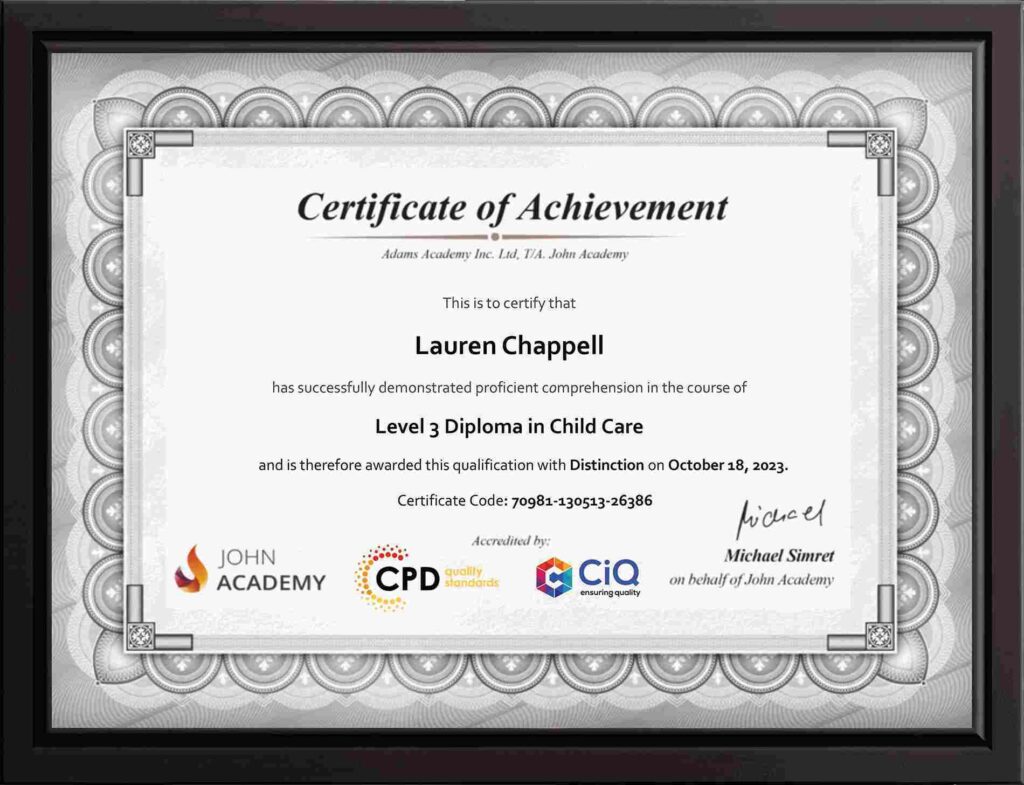
After completing and passing the course successfully, you will be able to obtain an Accredited Certificate of Achievement. Certificates can be obtained either in hard copy at a cost of £39 or in PDF format at a cost of £24.
Who is this Course for?
Family Support Worker Course is certified by CPD Qualifications Standards and CiQ. This makes it perfect for anyone trying to learn potential professional skills.
As there is no experience and qualification required for this course, it is available for all students from any academic background.
Requirements
Our Family Support Worker Course is fully compatible with any kind of device. Whether you are using Windows computer, Mac, smartphones or tablets, you will get the same experience while learning. Besides that, you will be able to access the course with any kind of internet connection from anywhere at any time without any kind of limitation.
Career Path
After completing this course you will be able to build up accurate knowledge and skills with proper confidence to enrich yourself and brighten up your career in the relevant job market.
-
 The functions, work environment, and daily activities of a family support worker 00:15:00
 -
The key responsibilities of a family support worker and different specialisations 00:15:00
-
The key qualities of a family support worker and what a family support worker should expect 00:15:00
-
Duties as a family support worker 00:15:00
-
Professional development, career prospects, and anticipated salary as a family support worker 00:05:00
-
A day in the life of a family support worker 00:15:00
-
Pros and cons of being a family support worker 00:05:00
-
Work-life balance as a family support worker 00:15:00
-
Top tips for family support workers 00:05:00
-
Introduction to legislation, policy, and guidance 00:05:00
-
Overview of legislation – England 00:15:00
-
The Children and Families Act 2014 00:30:00
-
Policy and guidance – England 00:15:00
-
Overview of legislation – Scotland 00:05:00
-
Policy and guidance – Scotland 00:15:00
-
Overview of legislation – Northern Ireland 00:05:00
-
Policy and guidance – Northern Ireland 00:05:00
-
Overview of legislation – Wales 00:05:00
-
Policy and guidance – Wales 00:05:00
-
Parental mental health – how to help children living with parents with mental health problems 00:15:00
-
Parental mental health – assessing the risk of mental health problems 00:05:00
-
Parental mental health – intervention and support for children and families 00:15:00
-
Parental substance misuse – how to help children living with parents who misuse alcohol and drugs 00:05:00
-
Parental substance misuse – assessing the risk of parental alcohol and drug misuse 00:05:00
-
Parental substance misuse – intervention and support for children and families 00:05:00
-
Domestic abuse – what is domestic abuse? 00:05:00
-
Separation, divorce, and parental responsibility 00:05:00
-
Separation, divorce, and contact 00:05:00
-
General advice on talking about difficult topics 00:15:00
-
Books to help talking about difficult topics 00:15:00
-
Introduction to safeguarding – a child-centred, coordinated approach 00:30:00
-
Early help 00:30:00
-
Access, referral, and information sharing 00:30:00
-
Disabled children, carers, youth establishments, and contextual safeguarding 00:15:00
-
Assessment purpose, protocols, principles, and parameters 00:15:00
-
Analysis, outcomes, and timeliness 00:30:00
-
Processes for managing individual Part 1 00:30:00
-
Processes for managing individual Part 2 00:15:00
-
Processes for managing individual Part 3 00:15:00
-
Types of family and what makes healthy families 00:15:00
-
Why relationships are key to good social work 00:30:00
-
The importance of relationships in social work to relationships in social work 00:30:00
-
The personal qualities required for relationship building 00:15:00
-
Working on empathy to build relationships 00:15:00
-
The professional attributes required for relationship building 00:15:00
-
Self-knowledge and professional use of self in relationship building 00:15:00
-
Taking an individualised approach, involving the parents, what parents want from the relationship, sharing information, and building trust 00:30:00
-
Challenges in relationship building 00:15:00
-
The difference between getting the relationship right and getting it wrongb 00:30:00
-
Order Your Certificates and Transcripts
What Our Students are Saying

Sam Carpenter
John Academy has helped me in my development, and I took the courses seriously and gained a qualifications certificate, which I've wanted to do for a long time. I highly recommend it, and a few friends have signed up, too. Thank you, John Academy.
Georgina Salazar
Easy to access, generous options for multiple learning and approaches. Supportive team.
Wayne Wright
The course empowers me to make my dreams come true. The course material was excellent. John Academy is good to study.
Romina
I am thankful that I have chosen John Academy for my online courses. It has given me a platform where I have learned a lot. It has so many reading materials with a handful of knowledge. Once again, thank you so much to the John Academy support team, who has cooperated & supported me throughout this journey.
Peter Gilbert
Brilliant course, with so many to choose from, very good value and a certificate at the end. Quick turnaround to receive a certificate. Very good academy I have completed several and have 2 ongoing at the moment. Never had any problems. Excellent customer service. Would recommend.

Other Students Also Bought
No course found