Table of Contents
Climate scientists, governments and humanitarian organisations are on high alert for a shift in the Pacific Ocean. Following a few quiet years, El Niño is coming back, and this time, it’s coming to a world that’s already getting warmer than ever before. If you’ve been seeing the word in news headlines and weather reports recently, you’ll want to read this article to learn what it is, why it’s important and what it might mean for you, your community, and the planet.
What Is El Niño? Understanding the Basics
The word “El Niño” comes from Spanish, literally “the boy” or “the Christ child”. The South American fishermen who named it in the 19th century noticed that the warm ocean waters frequently washed up around Christmas time and had a disturbing effect on their fishing off the coast of Peru.
El Niño is a natural climate phenomenon at its core. It is the name given to a warming of the sea surface temperature over the central and eastern equatorial Pacific Ocean that occurs from time to time. This warming is not a random event, but rather part of a complex system referred to as the El Niño-Southern Oscillation (ENSO) that also involves the cooling El Niño.
In normal Pacific conditions, the trade winds blow to the west around the equator, carrying warm surface waters toward Australia and Southeast Asia. The nutrient-rich and cooler water rises to the surface in the eastern Pacific near South America. In an El Niño climate event, the trade winds weaken or even reverse. Warm water cascades back up eastward, warming up sea surface temperatures and significantly influencing global weather patterns.
How Often Does El Niño Happen? The Years of El Niño
One of the most common questions people ask is, ‘How frequently does this happen?’
The years of El Niño events are not regular, but it generally happens every two to seven years, as per the United Nations. Most events are about 9 to 12 months in duration, but some were more severe and lasted longer.
Significant El Niño events in the last few decades have been:
- 1982–1983: Unusually severe drought and flooding around the world, especially across multiple continents, according to the World Meteorological Organization.
- 1997–1998: The strongest El Niño of the 20th century had impacts on monsoons, causing wildfires in Southeast Asia and severe flooding in South America (United Nations).
- 2015–2016: A devastating event that impacted over 60 million people worldwide, causing food insecurity, flooding, and health emergencies in Latin America, Africa, and Asia (according to the United Nations).
- 2023–2024: The 5th highest-intensity El Niño in history, which contributed to record-high global temperatures and global disruption, according to the World Meteorological Organization (WMO).
- 2026: And now, according to the World Meteorological Organisation (WMO), El Niño is back (according to the United Nations).

The 2026 Return: What Scientists Are Saying Right Now
This is NOT a future forecast. This is happening in actuality.
The WMO has verified in its latest update (May 2026) that sea surface temperature anomalies in the central-eastern equatorial Pacific are quickly increasing. Climate models from global producing centres have converged to a remarkable degree. The WMO has now increased the likelihood of an El Niño developing in the June-July-August (JJA) season to 80% (about 90% for September-December).
WMO Secretary-General Celeste Saulo said that El Niño conditions are actively developing in the tropical Pacific and are anticipated to impact weather and climate throughout the world in the next few months. The models are now in strong agreement with high confidence in the beginning and further strengthening of the event, said the organisation’s chief of climate prediction, Wilfran Moufouma Okia.
NOAA (the US National Oceanic and Atmospheric Administration) says it, too, without beating around the bush. As of May 2026, it has a probability of 82% for El Niño to form in the summer and a 96% probability for it to persist into the Northern Hemisphere winter 2026–27.
The models are pretty consistent that this event will be at least moderate, and it could be a really strong event.
El Niño Weather: What Changes Around the WorldNow
Regional Impacts of El Niño
Understanding El Niño weather means understanding that its effects are not uniform. The same phenomenon that brings drought to one continent can cause flooding in another. The table below provides a region-by-region breakdown of the typical patterns associated with an El Niño event.
| Region | Typical El Niño Impact |
|---|---|
| East Africa | Increased rainfall and flooding |
| Southern Africa | Drought and reduced crop yields |
| Southeast Asia & Australia | Drier conditions, increased wildfire risk |
| South America (Western) | Heavy rainfall and flooding |
| India & South Asia | Weakened monsoon, drought risk |
| Southern USA | Wetter conditions, milder winter |
| UK & Northern Europe | Indirect effects: slightly milder, wetter winters |
El Niño influences weather patterns across the globe, often creating opposite effects in different regions. Understanding these regional impacts helps governments, businesses, farmers, and communities prepare for potential climate-related challenges.
"A strong El Niño can send ripples through the entire global climate system, affecting food production, water availability, ecosystems, and economies across continents." — Professor Liz Stephens, University of Reading
The El Niño Effect: Why It Hits Harder Now
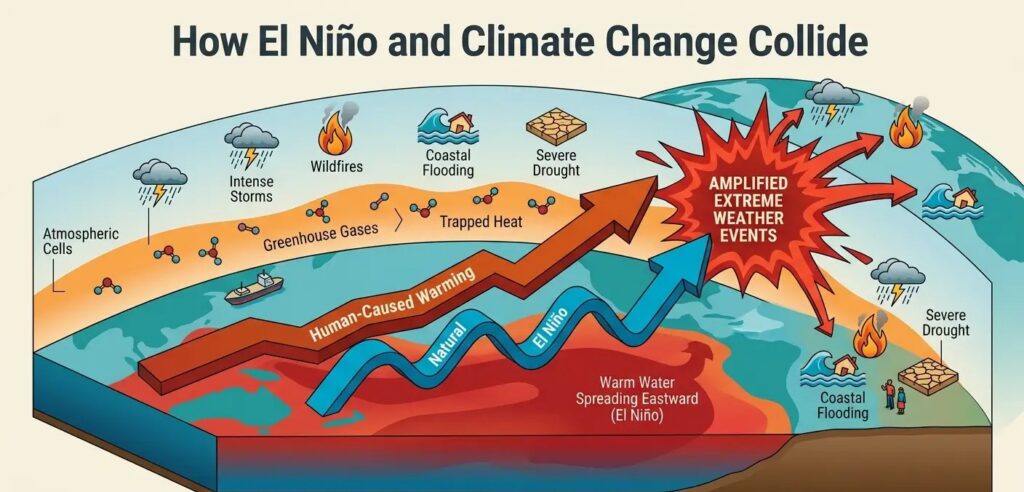
The El Niño phenomenon has always been strong. However, scientists have become more aware than ever of its effects being magnified by climate change caused by humans.
There is an important difference: El Niño is a natural phenomenon. Climate change and El Niño are different phenomena, although they can interact. Now, what is happening is that these 2 forces are colliding with each other.
El Niño also brings a temporary “heat overlay” to an already warming baseline when the Pacific is warm. Together with the multi-decadal warming from GHGs, the 2023–2024 El Niño contributed to 2024 being the hottest year on record globally, the first year to exceed the 1.5°C warming limit agreed upon by the Paris Agreement.
When El Niño occurs, it can lead to greater heat, greater extremes and greater global and real-world impacts on societies and economies, as researchers at the National Centre for Atmospheric Science (NCAS) in the UK explained. As the ocean and atmosphere warm up, more energy and moisture are available, allowing extreme weather events to be fuelled more strongly, such as heatwaves, heavy rainfall, and wildfires.
Scientists are also confident that, at the moment, there is no clear evidence that El Niño events are becoming more frequent in general as a result of climate change. What it does do is make, when they do come, the effects of each event worse.
What Does This Mean for the UK?
El Niño does not affect the British Isles in the same way as it affects Southeast Asia or South America. The UK is located in a temperate region, with weather being controlled by the Atlantic and the jet stream. But it shouldn’t be taken for granted that the UK is immune.
The impacts on the UK weather are generally small but not negligible:
- Milder-than-average temperatures: during autumn and early winter, driven by westerly or south-westerly wind patterns
- Wetter conditions: in winter, particularly in later months following an El Niño peak
- Lagged effects: recent research from the Met Office and academic partners suggests that the influence of ENSO on UK and Atlantic weather systems can appear up to a year after the El Niño phase, meaning stormier conditions in subsequent winters are a plausible outcome
But the effect in the UK is more indirect. What occurs in the tropical Pacific does not remain in the Pacific, as Professor Tim Osborn of the University of East Anglia points out. El Niño affects global food production, impacting food chains. If it ignites humanitarian crises in Africa or South Asia, then the repercussions of migration pressure, commodity prices, international aid demands, and so on are felt around the globe – including in Britain.
In reality, household consumers, farmers and businesses in the UK can expect to:
- Potential increases in food prices due to global crop disruptions
- Heightened risk of supply chain volatility for tropical commodities such as coffee, cocoa, palm oil, and rice
- A possible increase in heating bills if winter turns unpredictably cold in later months after a milder start


El Niño's Impact on Food, Health, and Ecosystems
The El Niño phenomenon extends into some of the basic elements of human life, in addition to weather.
Food Security
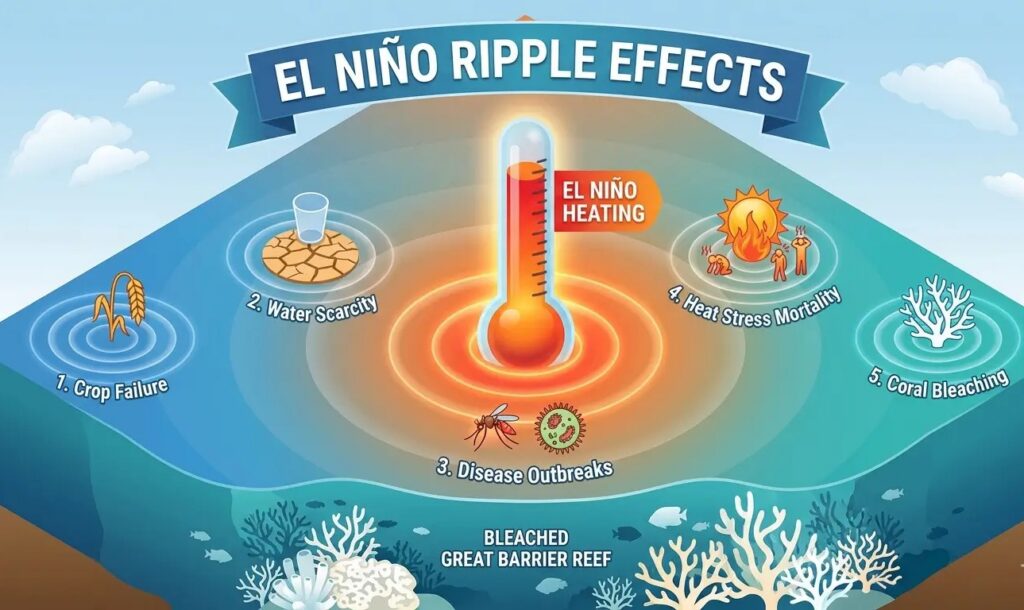
In 2023-2024, India, the world’s biggest exporter of rice, temporarily curbed exports due to a surge in domestic prices. Crops of cereal grains fell in southern and eastern Africa due to drought. During dry periods caused by El Niño, crop production in some of the world’s most vulnerable food-insecure areas is depleted, bringing millions of people closer to the brink.
Public Health
There are well-established links between El Niño and health:
- Access to safe drinking water is limited during drought, leading to an increased risk of waterborne diseases.
- Malaria and cholera outbreaks can occur when heavy rain and flooding are experienced in East Africa and South Asia.
- El Niño amplification leads to an increase in heat stress-related mortality, especially for vulnerable groups during heat waves.
- There is one bright side: El Niño is also historically known to bring a less active Atlantic hurricane season, so there is some relief in that area, but East Pacific storms rise.
Ecosystems
Coral reefs in particular are sensitive. Mass bleaching occurs when ocean surface temperatures are warm, during El Niño. The Great Barrier Reef has suffered from severe bleaching in the previous El Niño, and with temperatures already high in the ocean, another El Niño could be catastrophic for the reef ecosystems that have not yet recovered.
What Should Governments and Communities Do Now?
Forecasts are not only information, but they are a call to action; the WMO has been clear.
The organisation notes that 128 countries have multi-hazard early warning systems at their disposal. To provide all communities with science-based advanced intelligence, with improved science-based decisions on crop strategy, water management, heat preparedness, and storm preparedness.
The recommended actions for governments and local authorities are:
- Activating drought and flood preparedness protocols in at-risk regions
- Coordinating with humanitarian agencies ahead of potential food crises
- Communicating clearly with farmers and water authorities about expected seasonal shifts
- Strengthening early warning systems in coastal communities exposed to intensified storms
For individuals and households, particularly in the UK, practical steps include:
- Following updates from the Met Office and WMO for seasonal forecasts
- Farmers reviewing crop insurance and irrigation plans now, not later
- Businesses in the food and commodities sectors are reviewing supply chain resilience
- Staying informed about international aid situations that may affect trade and prices
A Note on What El Niño Is Not
It is important to discuss a common misconception. El Niño is not the same as climate change and isn’t caused by climate change. This is a natural process that has been happening on the earth for thousands of years, it is a part of the earth’s climate system. The context of its appearance is what’s different, and these contexts are each more impactful than they would have been in a world without the same decades of fossil fuel emissions.
One thing about the seasonal forecasting which should be noted is that there is a limit. The “spring predictability barrier” is a term meteorologists use to describe the season when forecasting at the beginning of spring is more uncertain. WMO has pointed out that despite the good model agreement at this time, there is some uncertainty regarding the exact intensity and the occurrence time of the event in 2026.
The UK's Position in the Global AI Economy
The UK is increasingly recognised as one of the world’s leading AI ecosystems.
Strengths include:
- World-class universities
- Strong research capabilities
- Thriving startup ecosystem
- International investment
- Advanced financial sector
- Government support for innovation
Cities such as London, Cambridge, Manchester, Bristol, and Edinburgh have become major centres for AI research and development.
This position gives the UK significant opportunities to attract talent, investment, and international partnerships in the coming years.
Conclusion
El Niño is back. Science is clear, the odds are great, and the consequences are worldwide. This is no hypothetical or abstract thing, but a very real factor which will impact rainfall, food costs, storm seasons, and public health outcomes on every continent in the coming 12 to 18 months.
As climate change continues to raise global temperatures, the return of El Niño could amplify weather extremes across many regions. Understanding its impacts and preparing early may help governments, businesses and households reduce risks in the months ahead.
FAQ:
AI is improving productivity, reducing costs, supporting innovation, and creating new employment opportunities across multiple sectors.
Healthcare, finance, manufacturing, retail, logistics, and public services are among the leading adopters of AI technologies.
AI is automating some routine tasks but is also creating new roles in technology, data science, cybersecurity, and AI management.
SMEs use AI for marketing, customer service, forecasting, accounting, and operational efficiency, helping them compete more effectively.
Skills shortages, data privacy concerns, ethical considerations, regulatory compliance, and workforce retraining remain key challenges.
Trending Posts
Learn smarter, grow faster
Explore our blogs and take your skills to the next level.



Course Categories
- Accounting & Finance
- Animal Care
- Beauty & Wellness
- Business
- Business & Management
- Career Bundles
- Employability
- English Language / Adult Education
- Finance
- Health & Fitness
- Healthcare, Safety & Fitness
- Hospitality
- HR and Leadership
- interactive course
- IT & Development
- IT, Software & Technology
- Job Ready Programme
- Language
- Lifestyle
- Management
- Marketing
- Personal Development
- Photography & Video
- Project Management
- Psychology
- Security
- Sports
- Teaching & Education
- Technology
- Therapy
- Web Development