Table of Contents
Mathematics has a reputation for being one of the most delicate subjects in school. Many students struggle with formulas, computations, and problem-solving styles, especially when assignments move quickly. Still, learning calculus briskly isn’t about being naturally blessed. In most cases, it comes down to using the right ways constantly.
Across the UK and around the world, education specialists increasingly agree that scholars learn calculus more effectively when they combine practice, understanding, and real- world operation. Whether you’re preparing for GCSEs, A-Levels, or university entrance examinations, or simply trying to ameliorate classroom performance, smarter study habits can dramatically speed up progress.
The good news is that calculus is a skill. Like learning a language or playing an instrument, it improves with deliberate practice and structured literacy. Scholars who formerly believed they were “bad at calculus” frequently ameliorate snappily when they change their approach.
This companion explores expert-backed tips that can help scholars learn calculus more quickly, retain generalities longer, and build genuine confidence.
Why scholars frequently find calculi delicate
Before perfecting calculus performance, it helps to understand why the subject feels grueling in the first place.
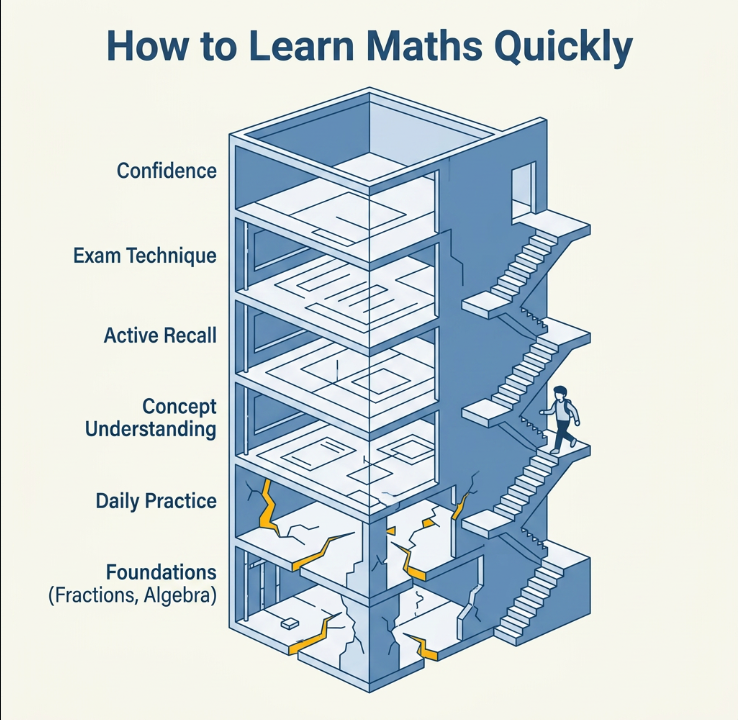
Math is accretive. Each piece of content builds on previous knowledge. However, probabilities, or algebraic manipulation, if a pupil misses an introductory conception similar as fragments.
Another common issue is unresistant literacy. Numerous scholars read exemplifications without actually working problems themselves. Math requires active engagement. Watching someone break equations isn’t the same as developing problem-solving capability.
Fear also plays a part. According to educational psychologists and tutoring experts, calculus anxiety can reduce attention and confidence during literacy and examinations. Scholars who anticipate failure frequently avoid practice, which slows progress further.
Fortunately, these problems can be addressed with better literacy strategies.
1. Build a Strong Foundation First
One of the biggest reasons scholars struggle with calculus is weak foundational knowledge.
Trying to break advanced algebra without understanding computation basics is like erecting a house on unstable ground. Before moving to harder motifs, scholars should readdress essential generalities, including:
- Fragments, numbers, and probabilities
- rates and proportions
- Introductory algebra and equation rearrangement
- Times tables and internal computation
Scholars in the UK frequently discover these gaps while preparing for GCSE calculus examinations because numerous advanced topics rely heavily on these core concepts. A pupil learning trigonometry may struggle not because trigonometry is unsolvable but because they’re uncomfortable rearranging equations.
A practical approach is to spend one week relating to weak areas. Break simple exercises from former academy times and note any miscalculations. Fixing these gaps can speed up learning dramatically.
2. Understand Concepts Instead of Memorising
Many students try to memorise formulas without understanding how they work. This may help temporarily, but it generally fails during examinations or strange questions.
Fast calculus learners concentrate on understanding patterns and sense. When scholars understand why a formula works, they can apply it more confidently in different situations. For illustration, rather than memorising the area formula for triangles blindly, scholars should understand that it comes from halving the area of a square.
When learning new content, always ask.
- Why does this system work?
- Where is it used in real life?
- What changes if the figures change?
This approach improves long-term retention and problem-solving speed far more effectively than rote memorisation alone.
3. Practise Daily, Even for Short Periods
thickness matters more than lengthy study sessions.
Educational experts frequently recommend shorter, concentrated calculus exercise sessions rather than studying for several exhausting hours a week. A pupil who practices calculus for 30 twinkles daily generally improves faster than someone who studies only before tests.
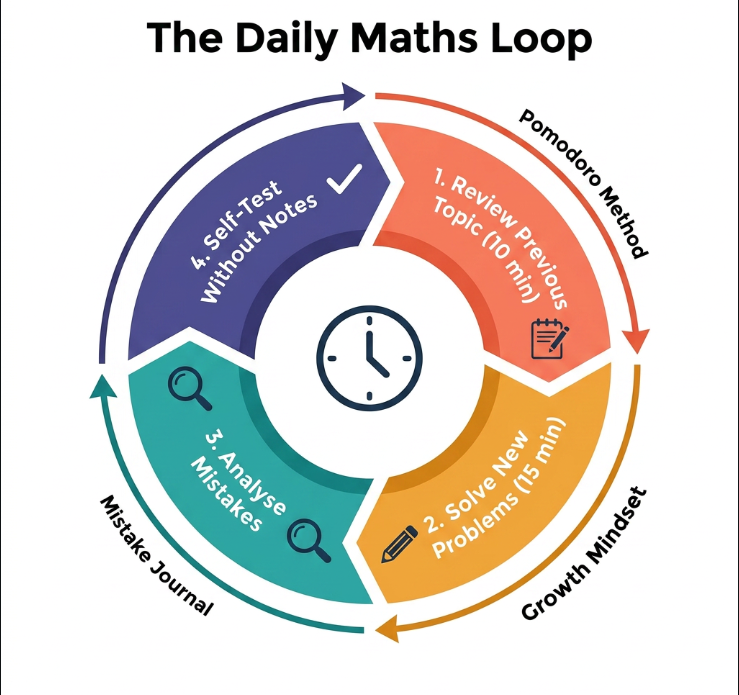
Daily practice helps the brain honour patterns more quickly. It also reduces forgetting. An effective routine could look like this:
Study Activity Schedule
| Time | Activity |
|---|---|
| 10 minutes | Review the previous topic |
| 15 minutes | Solve new problems |
| 5 minutes | Check mistakes and corrections |
This simple structure keeps learning active without becoming overwhelming.
4. Learn Through Mistakes
Strong math scholars aren’t scholars who never make miscalculations. They are students who analyse mistakes carefully.
Numerous learners rush through corrections or ignore wrong answers fully. This slows enhancement significantly because every error contains useful information. Rather than feeling frustrated, scholars should produce a devoted “mistake tablet” and record
- The original question and its incorrect approach
- The correct system and final answer
- The specific reason the mistake passed
Reviewing this tablet regularly prevents repeated crimes and builds a greater tone of mindfulness about particular learning gaps. Over time, scholars begin to notice patterns in their miscalculations and address them directly rather than repeating the same mistakes across multiple assessments.


5. Use Active Recall and Self-Testing
One of the fastest ways to strengthen maths memory is active recall.
Rather than rereading notes constantly, scholars should test themselves constantly. Exploration in cognitive wisdom shows that reacquiring information from memory strengthens it more effectively than unresistant review alone.
For maths learners, this means working on questions without looking at exemplifications, rewriting formulas from memory, and explaining results audibly before checking answers. For example, after learning contemporaneous equations, close the text and break a fresh problem singly.
Still, that struggle is actually helping the brain learn, if the result feels delicate. Tone testing also prepares scholars psychologically for real test conditions, gradually reducing performance anxiety over time.
6. Break Difficult Problems Into Smaller Steps
Complex maths questions frequently look intimidating because scholars try to break everything at formerly.
Expert teachers constantly educate scholars to divide large problems into manageable chunks. This strategy is especially useful for
- GCSE Higher Maths and A-Level examinations
- Multi-step calculus and algebra problems
- Physics-related mathematical calculations
- Word problems requiring interpretation before calculation
Fastening on one step at a time reduces internal pressure and makes the overall process feel attainable. Scholars who develop structured problem-solving habits frequently complete questions briskly and with fewer errors than those who attempt to work through everything simultaneously.
7. Apply Maths to Real-Life Situations
One reason scholars lose motivation is that maths can feel disconnected from daily life. In reality, maths appears far and wide, and practical operation improves understanding because the brain retains useful information more easily.
Students can connect maths to everyday situations, such as:
- Calculating discounts and comparing prices while shopping
- Measuring and adjusting ingredient quantities when cooking
- Analysing sports statistics and league table positions
- Planning travel routes and estimating journey times
For example, chance computations come easier when comparing trade abatements. Probability becomes clearer when considering rainfall predictions or match issues. Preceptors across the UK increasingly encourage contextual literacy because it helps scholars connect abstract ideas to practical use.
8. Study in Focused Sessions Without Distractions
Modern distractions reduce learning speed significantly. Many students attempt to study maths while checking social media, watching videos, or replying to dispatches. This weakens attention and increases the liability of committing crimes.
Maths requires deep focus because problem-solving depends on working memory. A useful strategy is the Pomodoro method. Study for 25 minutes with complete focus, take a five- nanosecond break, and repeat the cycle.
During each study session, scholars should turn off all announcements, keep only needed accoutrements in the office, and choose a quiet and harmonious study terrain. Concentrated sessions of moderate length constantly produce better results than longer sessions filled with interruptions.
9. Teach Someone Else What You Learn
Teaching is one of the fastest ways to master maths. When scholars explain generalities to another person, they snappily discover gaps in their own understanding.
For illustration, if a pupil can not easily explain how to break quadratic equations step by step, they may not completely understand the process yet. Tutoring can be in several practical ways:
Explain a homework method to a friend or classmate
Walk a younger sibling through a topic they are studying
Talk through a full solution aloud before writing it down
Record a short video of yourself explaining a method clearly
This approach forces active thinking, strengthens memory, and reveals misconstructions that resistant study frequently leaves unaddressed. Numerous high-performing scholars use this strategy naturally without realising how effective it truly is.
10. Use Quality Online Resources Wisely
Students today have access to more maths resources than ever before. Educational platforms, videotape tutorials, interactive exercises, and online modification tools can accelerate literacy when used properly.
However, too many coffers can come invitingly. Rather than jumping between arbitrary vids, scholars should choose structured and dependable platforms aligned with their class.
A practical strategy is to learn the concept from one trusted source first, practise singly using questions, and also review miscalculations precisely before moving on. This process prevents information overload and keeps learning concentrated on genuine understanding rather than resistant content consumption.
Many UK students preparing for GCSEs and A-Levels profit from class- aligned platforms that follow specific test board conditions and give worked exemplifications in familiar formats.
11. Develop Strong Exam Techniques Early
Learning maths quickly also means learning how exams work. Many students understand concepts clearly but still lose marks because of poor exam technique rather than knowledge gaps.
Strong test habits include showing all working easily at every stage, managing time precisely across the full paper, reading each question completely before beginning, and checking answers totally before submission.
In UK GCSE maths examinations, system marks are constantly awarded, indeed, when the final answer contains an error. Students who show clear work always give themselves the stylish chance of entering partial credit.
Completing one’s papers regularly under timed conditions is one of the most effective medication strategies available. It helps scholars honour common question styles, make speed, identify remaining weak motifs, and reduce anxiety through familiarity with the format.
12. Use Visual Learning Techniques
Many students understand maths more easily through visual representation than through the textbook and symbols alone.
Graphs, plates, colour-enciphered notes, and visual models make abstract generalities significantly more accessible. Linear equations come easier to interpret when scholars can see how changing a value shifts a graph. The figure becomes far clearer when working from an accurate illustration rather than a written description.
Students who infrequently encounter visual tutoring in class can produce their own. Sketching a quick illustration before beginning a problem, drawing a number line when working with negative values, or colour-rendering different terms in an algebraic expression are simple habits that reduce errors and improve overall clarity.
13. Build Confidence and Stay Patient
Confidence affects maths performance more than numerous scholars realise. Students who constantly tell themselves they’re “bad at math” frequently avoid delicate problems and give up too quickly. In discrepancy, confident learners view miscalculations as a natural part of the enhancement process.
Building math confidence takes time, but small triumphs accumulate meaningfully. Working on one delicate problem singly, perfecting a test score by many marks, or eventually understanding a concept that initially caused confusion—these gestures produce genuine inspiration that carries forward into further challenging work.
Students should flash back to the fact that fast literacy doesn’t mean instant mastery. Harmonious trouble over weeks and months produces the kind of deep understanding that lasts well beyond any single test.
Common Habits That Slow Maths Learning
Some study habits appear productive but actually reduce progress considerably.
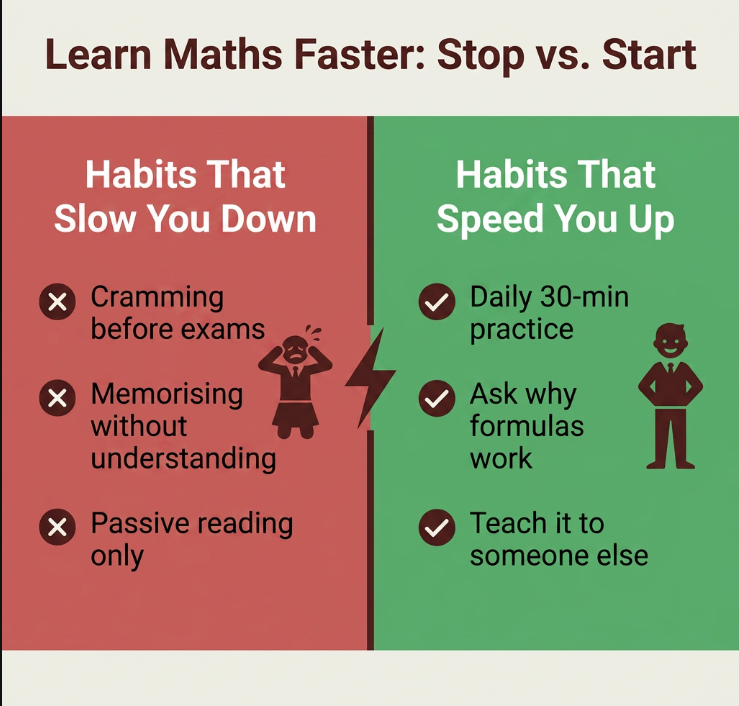
Overreliance on calculators is a frequent issue. While calculators are useful tools, students still need strong internal computation and estimation chops to work efficiently and spot unreasonable answers quickly.
Memorising procedures without understanding causes confusion whenever questions are stated otherwise or bear a slightly different approach than expected.
Cramming before examinations is also ineffective for maths because the subject relies on accretive understanding erected steadily over time. Students who leave modification to the final days tend to perform inconsistently and forget material quickly after assessments have passed.
The Importance of a Growth Mindset in Maths
Educational experimenters worldwide constantly highlight the importance of mindset in academic learning.
A growth mindset means believing that capability develops through trouble, practice, and effective strategy. Students with this mindset persist longer during delicate tasks, recover more readily from lapses, and use feedback constructively rather than defensively.
Brain development exploration suggests that harmonious literacy strengthens neural connections over time. Math capability isn’t fixed at birth. It grows with practice, and scholars who authentically believe this tend to put in the harmonious trouble that produces real and continuing enhancement.
When to Ask for Extra Help
Sometimes, independent study isn’t enough, and recognising this early is important.
Students should seek redundant support when they feel wedged on the same content constantly despite genuine trouble, when calculi anxiety is affecting diurnal attention or performance, or when progress has stalled despite harmonious practice habits.
Extra help may come from classroom preceptors, private teachers, organised study groups, or structured online literacy communities. Asking for help beforehand prevents small misconstructions from developing into larger gaps that affect performance across multiple affiliated motifs.
There’s no shame in demanding guidance. Numerous successful students ameliorate fleetly once they receive targeted support from someone who can identify exactly where understanding has broken down.
Conclusion
Learning maths quickly is possible for most students, but it rarely happens through shortcuts alone.
The fastest progress generally comes from erecting strong foundations, exercising daily, engaging laboriously with material, and treating miscalculations as learning opportunities rather than failures.
Students who understand generalities rather than memorising procedures retain information longer, acclimatise more readily to strange questions, and approach examinations with genuine confidence.
Most importantly, scholars should recall that enhancement in calculi is gradational. Indeed, little diurnal progress accumulates significantly over weeks and months. A pupil who practices constantly, reflects on their miscalculations, and stays calm can ameliorate fine capability far more quickly than they might originally anticipate.
Math isn’t just about figures. It’s about developing the capability to suppose logically, approach problems methodically, and persist through difficulty rates that serve scholars well far beyond the classroom.
Frequently Asked Questions (FAQs)
The fastest way to learn maths is by combining strong foundational knowledge, daily practice, and a deep understanding of concepts instead of memorisation. Consistent short study sessions, active problem-solving, and reviewing mistakes help improve speed and accuracy over time.
Students often struggle because maths is cumulative—missing basic concepts makes advanced topics harder. Other reasons include passive learning (just reading instead of practicing), maths anxiety, and lack of consistent study habits.
Yes, daily practice is essential. Even 20–30 minutes a day helps reinforce concepts, improve problem-solving skills, and reduce forgetting. Regular practice is more effective than long, irregular study sessions.
Understanding formulas is far more important than memorising them. When students understand how and why a formula works, they can apply it to different types of problems and adapt more easily in exams.
Students can improve by practicing past papers under timed conditions, showing all steps clearly, managing time effectively, and regularly self-testing. Learning from mistakes and building strong exam techniques also play a key role.
Trending Posts
Learn smarter, grow faster
Explore our blogs and take your skills to the next level.



Course Categories
- Accounting & Finance
- Animal Care
- Beauty & Wellness
- Business
- Business & Management
- Career Bundles
- Employability
- English Language / Adult Education
- Finance
- Health & Fitness
- Healthcare, Safety & Fitness
- Hospitality
- HR and Leadership
- interactive course
- IT & Development
- IT, Software & Technology
- Job Ready Programme
- Language
- Lifestyle
- Management
- Marketing
- Personal Development
- Photography & Video
- Project Management
- Psychology
- Security
- Sports
- Teaching & Education
- Technology
- Therapy
- Web Development