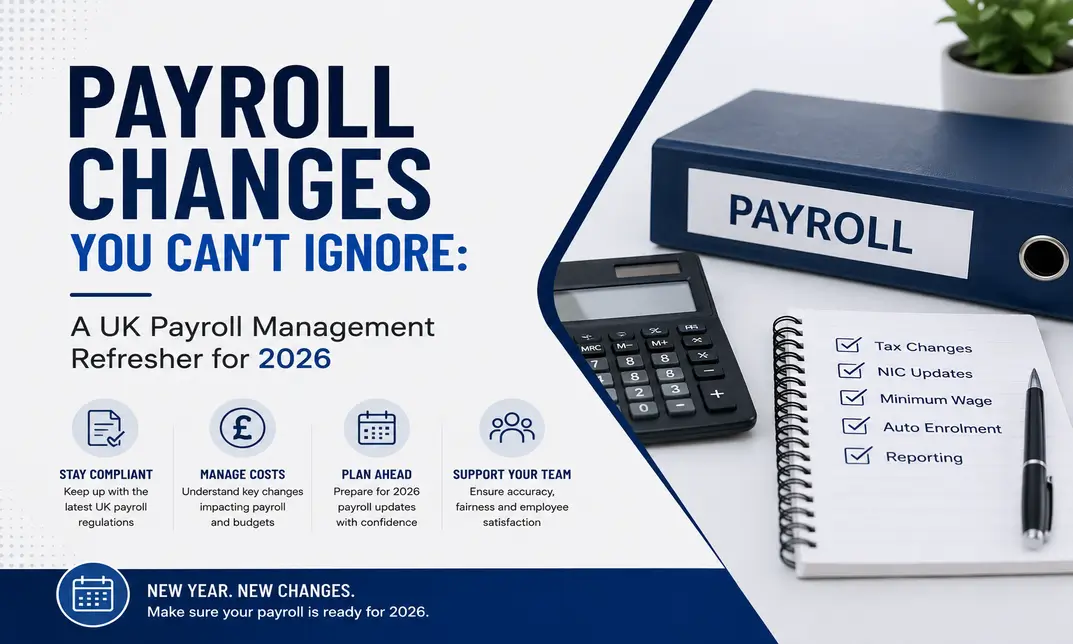
If you manage payroll for a UK business, whether it’s a five-person café, a growing SME, or a large organisation, 2026 has introduced several significant Payroll Management Refresher changes that employers can’t afford to ignore. From updated National Minimum Wage rates and Statutory Sick Pay reforms to new Employment Rights Act provisions and upcoming changes to benefits-in-kind reporting, payroll professionals must ensure their systems and processes remain fully compliant.
None of this is optional reading. Get it wrong, and you’re not just risking an awkward payslip query you’re risking HMRC penalties, employment tribunal claims, and the kind of reputational damage that’s hard to walk back. This refresher pulls together what’s actually changed, why it matters, and how payroll teams (in-house or outsourced) are adapting.
What Is Payroll, Really – And Why 2026 Is Different
At its simplest, what is a payroll? It’s the process of calculating and paying employee wages, deducting the right tax and National Insurance, and reporting all of it to HMRC on time, every time. Although payroll often appears to be an administrative function, it plays a vital role in ensuring employees are paid accurately, taxes are reported correctly, and businesses remain compliant with HMRC and employment legislation. Even small payroll errors can lead to financial penalties, employee dissatisfaction, and reputational damage.
What makes 2026 different is the sheer clustering of change. In a typical year, payroll administration deals with one or two rate updates. This year, employers are juggling wage increases, a fundamentally rebuilt statutory sick pay regime, new day-one entitlements under the Employment Rights Act, and preparation for mandatory payrolling of benefits in kind. Layered together, they change not just the numbers on a payslip but the underlying logic of how payroll systems need to be configured.
The Headline Change: National Minimum Wage Rates Rise From April 2026
Every April, National Minimum Wage and National Living Wage rates move, but the 2026 uplift was notable for how unevenly it landed across age bands. Workers aged 21 and over saw a solid increase, while younger workers and apprentices received a proportionally larger jump, continuing a multi-year push to close the pay gap between age bands. From 1 April 2026, workers aged 21 and over receive £12.71 per hour, up from £12.21, an increase of about 4.1%. Workers aged 18 to 20 moved to £10.85 per hour from £10, roughly an 8.5% rise, while those aged 16 to 17 and apprentices increased to £8 per hour from £7.55, around 6%. The daily accommodation offset, which applies when employers provide staff housing, rose to £11.10 from £10.66.
National Minimum Wage Rates (UK)
| Worker Category | Rate from 1 April 2025 | Rate from 1 April 2026 | Approx. Increase |
|---|---|---|---|
| 21 and over (NLW) | £12.21 | £12.71 | 4.1% |
| 18–20 | £10.00 | £10.85 | 8.5% |
| 16–17 & apprentices | £7.55 | £8.00 | 6.0% |
| Accommodation offset (daily) | £10.66 | £11.10 | 4.1% |
A real-world scenario worth sitting with: a retail employer with a mix of 17-year-old Saturday staff and 22-year-old supervisors can’t simply apply a flat percentage bump across the board. Each age band moved by a different amount on the same date, and any salary sacrifice arrangement, pension contributions in particular, now needs rechecking to make sure it doesn’t accidentally push someone’s effective pay below the legal minimum. That’s a classic and entirely avoidable compliance trap.
The same set of April 2026 regulations also nudged National Insurance thresholds, with the Lower Earnings Limit increasing to £129 per week. It’s a small figure, but it determines who falls inside the NI and statutory payments net, worth flagging to anyone running payroll manually or on older software that hasn’t been patched.
Statutory Sick Pay Just Changed Shape
If there’s one change payroll teams have felt most acutely this year, it’s Statutory Sick Pay. For years, SSP kicked in only after three “waiting days” and only for employees earning above the Lower Earnings Limit. That’s gone.
From 6 April 2026, Statutory Sick Pay is payable from the first full day of sickness absence, with the previous three-day waiting period removed. The Lower Earnings Limit has also been removed for SSP eligibility. Eligible employees receive either 80% of their average weekly earnings or the weekly SSP rate of £123.25, whichever is lower.
In practice, this means two things for anyone managing payroll:
- Payroll programmes and payroll systems need to recognise sickness from day one, not day four – a configuration change, not just a rate update.
- Businesses that previously relied on the waiting-day buffer to absorb short-term absence costs should budget for a real (if modest) increase in sick pay spend, particularly in sectors with high rates of short-notice absence like hospitality, retail, and care.
For a small business running payroll on a spreadsheet, this is the kind of change that’s easy to miss until an employee or HMRC flags it.
The Employment Rights Act's Wider Ripple Effect on Payroll
SSP isn’t the only thing the Employment Rights Act touched. From 6 April 2026, Paternity Leave and Unpaid Parental Leave became day-one rights, meaning employees can give notice to take these forms of leave from their first day of employment. However, the service requirement for Statutory Paternity Pay remains unchanged.
Statutory family leave payments, covering maternity, paternity, adoption, shared parental, parental bereavement and neonatal care pay, rose to £194.32 per week, where the minimum cap applies, up from £187.18. Separately, From 7 April 2026, the new Fair Work Agency began bringing several employment-rights enforcement functions together, including enforcement relating to National Minimum Wage compliance. For payroll teams, this makes accurate wage calculations, records and compliance checks even more important.
None of these are payroll calculations in isolation, they’re eligibility rules that payroll now has to apply correctly from an employee’s very first day, which is a genuine shift in how HR and payroll teams need to talk to each other. A new starter who announces they’re expecting a child in week two can no longer be told to “wait and see” their entitlement exists from day one, and payroll needs the process to reflect that immediately, not retroactively.


Unfair Dismissal Reform: Prepare Before January 2027
Another employment law change on the horizon is the planned reduction of the qualifying period for ordinary unfair dismissal claims. From January 2027, the qualifying period is expected to reduce from two years to six months.
Although this is not a payroll calculation itself, it matters to payroll, HR and management processes because employment records, start dates, absence records and termination documentation may become increasingly important when assessing employee rights and potential claims.
Businesses should therefore review their HR and payroll record-keeping processes now rather than waiting until the change takes effect.
Payrolling Benefits in Kind: The Quiet Revolution Building in the Background
This is the change that’s easy to overlook because its full effect hasn’t landed yet, but the groundwork is being laid right now, and it will reshape payroll processing for years to come.
Mandatory payrolling of benefits in kind has been delayed and is now being introduced in phases from April 2027. From 6 April 2027, mandatory payrolling will cover company cars, car fuel, vans, van fuel and employer-provided medical benefits. Most remaining benefits will follow from April 2028, while employer-provided loans and accommodation will be dealt with separately.
For employers, the key priority in 2026 is preparation rather than waiting for the deadline. Payroll teams should review their benefits data, check whether their payroll software can support the new real-time reporting requirements, and work with finance and HR to make sure benefit information is accurate and ready for the transition.
How Do I Do Payroll? Choosing the Right Approach for Your Business
This is the question every founder and finance lead eventually asks, usually the moment they hire their first employee. There isn’t one right answer, it depends on headcount, complexity, and how much risk you’re comfortable carrying in-house.
Broadly, businesses running payroll in the UK fall into three camps:
In-house payroll administration. A dedicated person or small team manages payroll directly, often using dedicated payroll software or an integrated payroll application. This gives maximum control but means someone internally has to stay current on every rate change, every Employment Rights Act update, and every HMRC reporting requirement, a genuinely demanding job when the regulatory calendar looks like 2026’s does.
Managed payroll services (outsourced). A specialist payroll services provider or accountancy firm takes on payroll processing, filings, and compliance monitoring on the business’s behalf. Managed payroll suits businesses that don’t want to build internal payroll expertise or that scale unpredictably and need flexible capacity. Payroll pricing here is usually per payslip or per employee, so costs scale with headcount rather than being a fixed overhead.
Payroll management system/software-led approach. Modern payroll software can also automate RTI submissions, pension calculations, statutory payments, employee self-service portals, and payroll reporting, helping businesses reduce manual errors while improving efficiency.
| Approach | Best suited for | Trade-off |
|---|---|---|
| In-house administration | Businesses with payroll expertise on staff | Full control, but staff must track every legislative change |
| Managed payroll services | SMEs wanting to offload compliance risk | Less day-to-day control, predictable ongoing cost |
| Payroll management system / software | Growing businesses wanting automation | Software handles the mechanics; someone still needs to review output |
Larger organisations, meanwhile, often need enterprise payroll software capable of handling multiple pay frequencies, multi-site operations, and integration with HR and finance systems—a different tier entirely from a simple payroll application built for a ten-person team.
What to Look for in a Payroll Management System in 2026
Given everything above, a payroll management system worth its subscription in 2026 should, at minimum, handle age-banded minimum wage checks automatically, apply day-one SSP without manual intervention, and offer a clear route into voluntary payrolling of benefits in kind ahead of the 2027 mandate.
It’s also worth asking any payroll systems UK vendor directly how quickly they update rate tables after government announcements, the gap between an HMRC confirmation and a software update is exactly where compliance mistakes tend to slip through. A genuinely good system flags anomalies (an hourly rate below the new minimum, for instance) rather than silently processing them.
A Practical Compliance Checklist for the Rest of 2026
For any business, whether payroll sits in-house or with a managed payroll provider, a few actions are worth prioritising before year-end:
- Audit current pay rates against the new age-banded minimum wage figures, paying particular attention to salary sacrifice schemes that could inadvertently breach them.
- Confirm your payroll software or provider has implemented day-one SSP correctly, with no lingering three-day waiting period in the system logic.
- Decide, with input from finance, whether voluntary payrolling of benefits in kind for 2026/27 makes sense ahead of the 2027 mandate, rather than leaving it as a last-minute scramble.
Common Mistakes Worth Avoiding
A few patterns show up again and again when payroll processes haven’t caught up with 2026’s changes.
The first is treating the minimum wage uplift as a single flat percentage rather than checking each age band separately, which is easy to do when payroll runs on a legacy spreadsheet rather than a proper payroll management system. The second is assuming SSP changes only affect large employers with high absence rates; in reality, even a business with two or three staff can be caught out by a new starter who’s off sick in their first week and, under the old rules, wouldn’t have qualified at all. The third is leaving benefits-in-kind decisions until the 2027 deadline is imminent, rather than using 2026 as a genuine trial period.
They’re the kind of thing that happens when payroll is treated as an administrative afterthought rather than a function that needs the same ongoing attention as tax or HR policy. A short quarterly review, checking rates, checking eligibility rules, and checking software update notes from your provider, catches most of it before it becomes a problem.
Conclusion
Payroll management in 2026 is about far more than updating pay rates. Employers must understand new legal requirements, maintain accurate payroll records, and ensure their payroll systems reflect the latest HMRC guidance and employment legislation.
Whether you manage payroll in-house or work with an outsourced payroll provider, staying informed and regularly reviewing your payroll processes will help reduce compliance risks and ensure employees are paid correctly.
For professionals looking to build confidence in payroll administration, a recognised Payroll Management course can provide practical knowledge of payroll calculations, statutory payments, HMRC reporting, and current UK payroll legislation.
FAQ:
Payroll management is the process of calculating employee pay, deducting tax and National Insurance, processing statutory payments, and reporting payroll information to HMRC.
Key changes include updated National Minimum Wage rates, day-one Statutory Sick Pay, revised family leave entitlements, and preparations for mandatory payrolling of benefits in kind.
While not legally required, payroll software helps businesses improve accuracy, automate HMRC reporting, and reduce compliance risks.
Yes. Many SMEs outsource payroll to specialist providers who manage payroll processing, statutory reporting, and compliance on their behalf.
Businesses should review payroll processes regularly and whenever HMRC announces legislative or tax changes.
Trending Posts
Learn smarter, grow faster
Explore our blogs and take your skills to the next level.


Course Categories
- Accounting & Finance
- Animal Care
- Beauty & Wellness
- Business
- Business & Management
- Career Bundles
- Employability
- English Language / Adult Education
- Finance
- Health & Fitness
- Healthcare, Safety & Fitness
- Hospitality
- HR and Leadership
- interactive course
- IT & Development
- IT, Software & Technology
- Job Ready Programme
- Language
- Lifestyle
- Management
- Marketing
- Personal Development
- Photography & Video
- Project Management
- Psychology
- Security
- Sports
- Teaching & Education
- Technology
- Therapy
- Web Development




0 responses on "Payroll Changes You Can't Ignore: A UK Payroll Management Refresher for 2026"