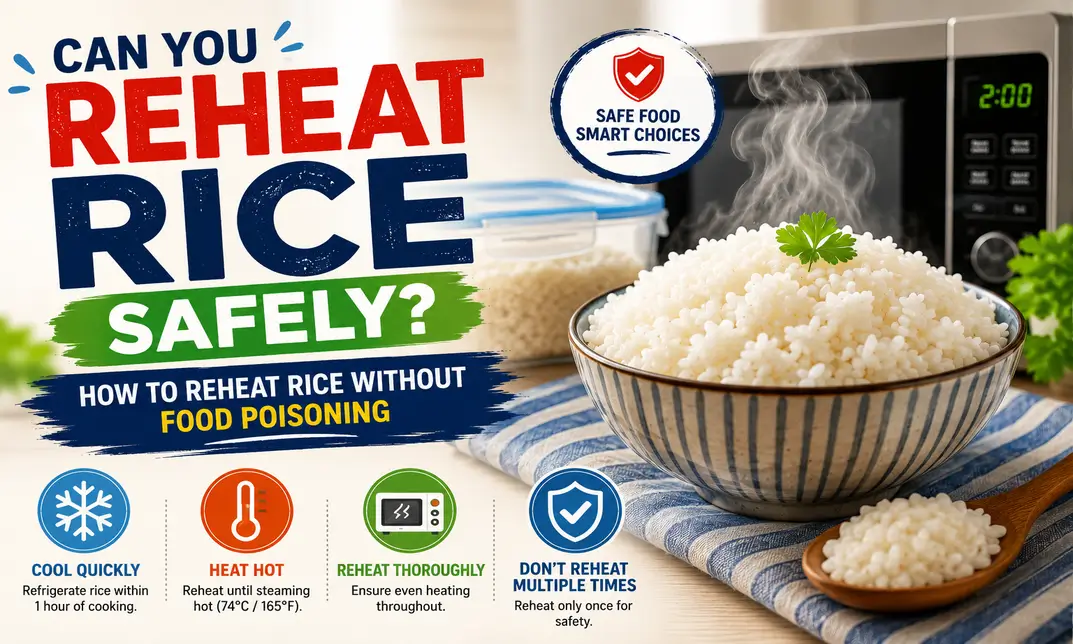
Most of us have stood at the fridge, wondering whether yesterday’s rice is still safe to eat. The good news is that you can reheat rice safely, provided it has been cooled, stored and reheated correctly. The main food-safety concern is Bacillus cereus, a bacterium whose spores can survive cooking and multiply if cooked rice is left at temperatures that allow bacterial growth.
In this guide, we’ll explain how to store cooked rice safely, how to reheat rice in the microwave and on the hob, whether you can reheat rice from frozen or takeaway containers, and when leftover rice should be thrown away.
So, can you reheat rice safely? Yes, but safe reheating starts with safe storage. How quickly the rice is cooled, how it is stored, and how thoroughly it is reheated all matter. In this guide, we’ll explain how to store cooked rice safely, how long you can keep it in the fridge or freezer, the safest ways to reheat it, and when leftover rice should simply be thrown away.
This guide walks through exactly what makes rice risky, how to store it properly, and how to reheat cooked rice using several different methods, including what to do with a leftover takeaway container or a bag of rice straight from the freezer.
Why Can Rice Cause Food Poisoning?
If you’ve ever been told to put cooked rice in the fridge quickly, there’s a good food-safety reason. Cooked rice can support the growth of Bacillus cereus if it is left at temperatures that allow the bacteria to multiply.
Raw rice can carry spores of a bacterium called Bacillus cereus. This bacterium is naturally present in soil, so it’s not a sign of dirty cooking or poor hygiene, it’s just part of how rice grows. The tricky part is that these spores are heat-resistant. Boiling or steaming rice kills most bacteria, but it doesn’t reliably destroy every spore.
Once cooked rice begins to cool, surviving Bacillus cereus spores can germinate and multiply if the rice remains at temperatures that allow bacterial growth. This is the part that catches people out: reheating rice kills active bacteria, but it does very little to neutralise toxins that have already formed. In other words, by the time you’re asking “can I reheat cooked rice that’s been sitting on the counter all afternoon?” the damage may already be done.
For example, leaving a large pot of cooked rice on the stove for several hours before refrigerating it can allow Bacillus cereus to multiply and produce toxins.
The Temperature Danger Zone
Bacteria can multiply rapidly when cooked food is kept at temperatures that support bacterial growth. For rice, the important point is to avoid leaving cooked rice at room temperature for extended periods. The longer cooked rice remains warm or at room temperature, the greater the opportunity for Bacillus cereus to multiply and produce toxins.
That’s why food-safety guidance focuses on cooling cooked rice quickly and refrigerating it promptly, rather than simply relying on reheating later.
Is It Okay to Reheat Rice? What the Evidence Actually Says
Here’s the reassuring part: reheating rice is not inherently dangerous. Yes, cooked rice can be reheated safely when it has been cooled and stored correctly. The important point is that reheating cannot make improperly stored rice safe again. If bacteria have multiplied and produced toxins while the rice was left at an unsafe temperature, reheating may not destroy those toxins.
In practical terms, safe reheating depends on three stages: cook safely, cool and store promptly, then reheat thoroughly.
So if someone asks, “Is it okay to reheat rice from last night?” the honest answer depends entirely on what happened to it after cooking, not on the fact that it’s being reheated at all.
Think of it less like a single rule and more like a chain. Every link needs to hold:
- The rice was cooled reasonably quickly after cooking
- It went into the fridge within a sensible window, not left out for hours
- It was reheated until piping hot all the way through, not just warm in places
If any link in that chain breaks, especially the cooling step, reheating won’t rescue the rice. This is the single biggest misconception people have, and it’s worth repeating: reheating is not a fix for poor storage. It only kills live bacteria, not the toxins some strains leave behind.
How Long to Reheat Rice — And to What Temperature
A lot of people ask how long to reheat rice, but time is actually the wrong thing to focus on. Temperature is what matters. Different appliances, portion sizes, and rice types will all take different amounts of time to get there.
When reheating rice, make sure it is steaming hot all the way through, with no cold or lukewarm areas. A food thermometer can provide an additional check if you’re unsure whether the centre has heated sufficiently.
The exact reheating time will depend on the quantity of rice, the appliance, and the starting temperature. Rather than relying on a fixed number of minutes, stir the rice during reheating and check that the entire portion is thoroughly hot before eating.
For a more precise safety check, UK food-safety guidance recommends reheating rice until it reaches a core temperature of 70°C for 2 minutes, or an equivalent temperature-time combination. It should be steaming hot throughout.
Rather than watching the clock, the better habit is to:
- Stir partway through reheating to redistribute heat
- Check the centre of the portion, not just the edges
- Look and listen for steam rising off the rice, not just warmth on the surface
Reheating time varies considerably according to portion size and equipment, so use the temperature and “steaming hot throughout” test rather than relying on a fixed number of minutes.
How to Reheat Rice Safely: Method by Method
There isn’t just one correct way to warm cooked rice. The right method often comes down to what you have on hand, how much rice you’re reheating, and what texture you’re after. Here’s a breakdown of the most practical approaches.
Reheating Rice in the Microwave
This is by far the most common way people reheat rice at home, and for good reason, it’s fast and simple.
A few practical tips make a real difference here. Add a splash of water (roughly a tablespoon or two per portion) before microwaving. This creates steam inside the covered dish, which helps heat the rice evenly instead of drying it out or leaving cold patches in the middle. Cover the bowl loosely with a lid or a damp piece of kitchen paper, and give it a stir halfway through.
If you’re wondering, “Can I reheat microwave rice?” that came pre-packaged, like the ready-to-eat pouches sold in supermarkets, most of these are actually designed to be cooked from ambient or chilled straight in the microwave. Always check the packet instructions, since these products often have their own specific timings.
Reheating Rice Without a Microwave
Not everyone has a microwave, and some people simply prefer the texture rice gets from other methods. Reheating rice without a microwave is entirely doable and arguably gives better results for certain dishes.
- Stovetop: Add the rice to a saucepan with a small splash of water or stock, cover with a tight lid, and heat gently on low to medium, stirring occasionally so it doesn’t catch on the bottom. This method tends to produce softer, fluffier results and works well for larger quantities.
- Steaming: For rice varieties like basmati or jasmine, steaming is often considered the best way to rewarm rice without sacrificing texture. Place the rice in a heatproof bowl over a pan of simmering water, cover, and let the steam do the work for several minutes. It’s gentler than a direct flame and helps avoid the gluey texture that can come from microwaving.
- Stir-frying: Day-old rice is actually a favourite among home cooks and chefs alike for fried rice, precisely because it’s slightly drier than freshly cooked rice. Heating oil in a wok, adding aromatics, then tossing in cold rice and stir-frying until piping hot is not just a reheating method, it’s practically a dish in its own right.
- Oven or air fryer: Less traditional, but useful if you’re reheating rice alongside other food already in the oven, or if you want crispier edges. Spreading rice on a tray with a light drizzle of oil and covering it loosely with foil helps prevent it from drying out completely.
Can You Reheat Rice from Frozen?
Freezing is genuinely one of the best options for rice you know you won’t eat within a few days, and reheating rice from frozen is both safe and convenient when done properly.
If you don’t plan to eat cooked rice soon, freezing it can be a useful option. Cool and portion the rice promptly, place it in suitable airtight containers or freezer bags, label it if necessary, and freeze it as soon as practical. Divide it into individual portions, place it in suitable airtight containers or freezer bags, label it with the date and freeze it promptly. You can defrost frozen rice in the refrigerator before reheating, or reheat it directly from frozen if the method and packaging allow it. Whichever approach you use, make sure the rice is thoroughly hot throughout before eating. Avoid repeatedly freezing, thawing, and reheating the same portion.
Can You Reheat Takeaway Rice?
Takeaway rice needs the same careful handling as rice cooked at home. The difficulty is that you may not know how long it was stored before you received it.
If you take leftover takeaway rice home, refrigerate it promptly rather than leaving it on the kitchen counter. If you don’t know how long the rice has been sitting at room temperature, don’t rely on smell or appearance to decide whether it is safe. When the storage history is uncertain, throwing it away is the safer choice.


How to Store Cooked Rice Safely
Getting the storage window right is arguably more important than any reheating technique. Here’s a simple reference table based on widely accepted food safety guidance:
Cooked Rice Storage Methods
| Storage Method | Recommended Approach | Key Point |
|---|---|---|
| Room Temperature | Keep exposure as short as possible | Don't leave cooked rice sitting out for extended periods |
| Refrigerator | Cool promptly and refrigerate | Follow current UK food-safety guidance |
If you're ever unsure how long rice has been sitting somewhere – a work fridge, a friend's kitchen, an unlabelled container – treat uncertainty as a reason for caution rather than assuming it's fine.
Reheating Methods Compared
Rice Reheating Methods
| Method | Best For | Watch Out For |
|---|---|---|
| Microwave | Speed, single portions | Uneven heating, dry patches without added water |
| Stovetop | Larger batches, fluffy texture | Sticking to the pan without enough liquid |
| Steaming | Delicate rice types (basmati, jasmine) | Takes longer than other methods |
| Stir-fry | Day-old or drier rice, fried rice dishes | Needs constant movement to heat evenly |
| Oven/air fryer | Crispy texture, reheating alongside other food | Can dry rice out without oil or covering |
How to Tell When Rice Should Be Thrown Away
This is the part that trips people up the most: Bacillus cereus toxins don’t always change how rice looks, smells, or tastes. That means the usual “sniff test” isn’t a reliable safety check on its own for this particular risk.
That said, there are still clear warning signs worth watching for, including a sour or unusual smell, a slimy or tacky texture, or any visible discolouration or mould. If you spot any of these, don’t try to rescue the rice by reheating it, throw it away.
Because appearance and smell can be misleading, timing and storage conditions remain the more trustworthy indicators. If you can’t confidently account for how the rice was handled, it’s not worth the gamble.
Common Mistakes People Make
A few habits come up again and again when people run into problems with reheated rice.
Leaving a full pot of rice to “cool on the side” for hours before transferring it to the fridge is one of the biggest culprits, since a large volume of rice cools far more slowly than a thin, spread-out layer. Reheating the same portion more than once is another issue, each cycle of cooling and reheating gives bacteria another opportunity to multiply, so it’s best to only reheat what you actually plan to eat in one sitting. Finally, relying on “it still smells fine” as the only safety check overlooks the fact that toxins can be present without any obvious warning sign.
Conclusion
Reheating rice is not inherently dangerous. The real food-safety risk comes from how cooked rice is handled before it reaches the fridge or freezer. Bacillus cereus spores can survive cooking, and if rice is left at temperatures that allow bacteria to multiply, reheating may not remove toxins that have already formed.
The safest approach is simple: cool cooked rice promptly, store it correctly, reheat only the portion you need, and make sure it is steaming hot throughout before eating.
If you’re unsure how long rice has been sitting out or how it was stored, don’t take the risk. Throwing away questionable leftovers is safer than relying on smell, appearance, or reheating to make them safe.
FAQ:
The safest recommendation is to reheat food only once. The FSA advises that leftovers should be reheated thoroughly until steaming hot throughout.
Yes. Properly stored cooked chicken can be reheated once. Make sure it is steaming hot throughout before serving.
Yes, but rice requires extra care. Cool it within one hour, refrigerate it promptly, eat refrigerated rice within 24 hours and reheat it only once.
It is safest to eat takeaway rice immediately because you may not know whether it has already been precooked and reheated. If you are unsure about its handling, do not reheat it.
It can be, provided the rice was safely cooled and stored first. Reheat it thoroughly, stir where appropriate and ensure it is steaming hot throughout.
Properly frozen rice can be reheated following safe defrosting and reheating practices. Do not repeatedly cool and reheat it after it has been defrosted.
For UK home cooking, the FSA advises reheating food until it is steaming hot throughout. The FSA also publishes safe time-and-temperature combinations, including 70°C for two minutes or equivalent, while food businesses commonly use a 75°C reheating target.
Trending Posts
Learn smarter, grow faster
Explore our blogs and take your skills to the next level.


Course Categories
- Accounting & Finance
- Animal Care
- Beauty & Wellness
- Business
- Business & Management
- Career Bundles
- Employability
- English Language / Adult Education
- Finance
- Health & Fitness
- Healthcare, Safety & Fitness
- Hospitality
- HR and Leadership
- interactive course
- IT & Development
- IT, Software & Technology
- Job Ready Programme
- Language
- Lifestyle
- Management
- Marketing
- Personal Development
- Photography & Video
- Project Management
- Psychology
- Security
- Sports
- Teaching & Education
- Technology
- Therapy
- Web Development



0 responses on "Can You Reheat Rice Safely? How to Reheat Rice Without Food Poisoning"