Whether you work in a kitchen, run a food stall, manage a café or prepare food for customers, you may have heard the term ‘HACCP’ during training or inspection. Someone may even have handed you a folder of temperature charts and said, “This is your HACCP.”
But HACCP is more than a folder of paperwork. It is a food safety management system that helps businesses identify what could go wrong, control food safety risks, and prevent unsafe food from reaching customers.
This beginner’s guide explains what HACCP means, the seven HACCP principles,
What Does HACCP Mean?
HACCP is an acronym for Hazard Analysis and Critical Control Point. That’s the official, full HACCP definition, but it’s a mouthful, so the rest of the industry goes for “HACCP”, pronounced “hass-up”.
In layman’s terms, HACCP is a systematic process for identifying potential hazards within food handling, storage, and service operations and implementing controls to prevent them from reaching the customer before they are consumed.
So, when an enquiring reader asks, What does HACCP mean in practice? The honest answer is this: it’s all about thinking ahead, not paperwork. It’s the difference between responding to a problem when somebody is ill and not having a problem ever reach the plate.
What Are HACCP Principles, Really?
HACCP has its roots in the space programme of the 1960s. NASA worked with Pillsbury and other food safety specialists to develop a system that could prevent food safety problems before they occurred. Testing finished food was not enough, because unsafe food could not be accepted during space missions.
This prevention-based approach later became widely used in food businesses, including restaurants, manufacturers, hospitals, care homes and catering operations.
Food safety in restaurants, factories, hospitals and care homes around the UK and globally today is based on the same principle. A prevention-based approach to discover issues at the end, rather than charting the process and monitoring the risk points throughout.
HACCP Definition: The Official Version
In simple terms, HACCP is a system for identifying food safety hazards and putting controls in place at the points where those hazards can be prevented, removed or reduced to a safe level.
HACCP is not just a document or checklist. It is a working process that should be reviewed when your menu, suppliers, equipment, layout or food handling process changes.
HACCP food safety is not a document and a single checklist but a process. It is a continuous process that is dynamic and can be changed as your menu, suppliers, or kitchen layout changes.
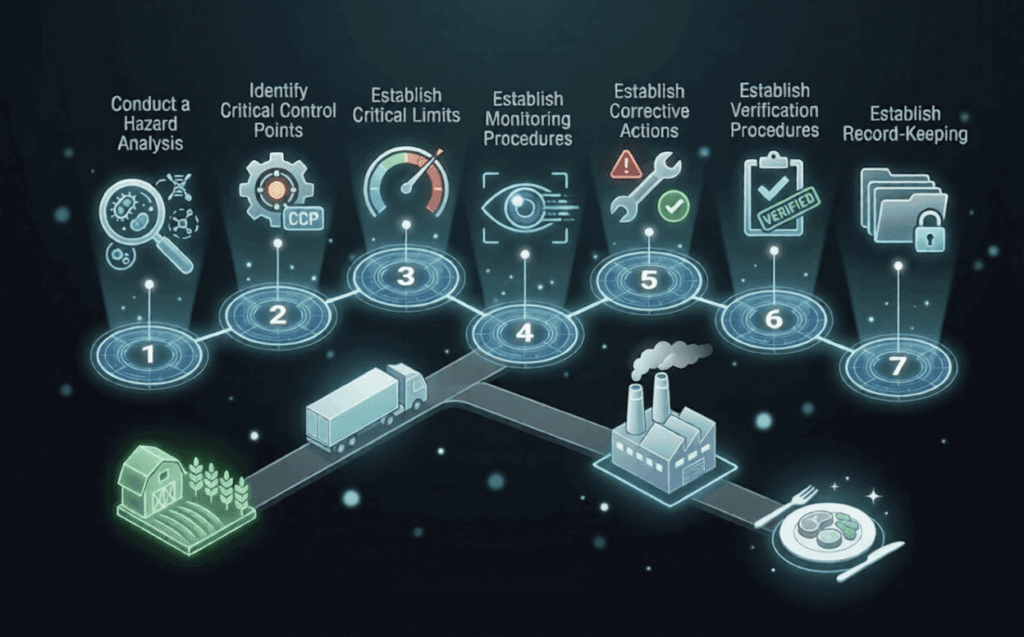
The Seven Principles of a HACCP System
Every recognised HACCP system, whether it’s used in a five-star hotel kitchen or a small independent bakery, is built around seven core principles. Understanding these is genuinely the fastest way to grasp the whole concept.
1. Conduct a Hazard Analysis
Walk through your entire process, from the moment ingredients arrive at your back door to the moment food reaches the customer. At each stage, ask, ‘What could realistically go wrong here?’
A practical example: if you run a small sandwich shop, your hazard analysis might flag that cooked chicken left at room temperature for too long could allow bacteria like Salmonella to multiply to dangerous levels.
2. Identify Critical Control Points (CCPs)
Once hazards are mapped, you identify the exact points in the process where you absolutely must apply a control to stop that hazard from causing harm. This is the heart of HACCP and food safety thinking: not every step needs a control, but the critical ones do.
For a butcher, a CCP might be the chiller temperature on delivery. For a caterer, it could be the core cooking temperature of a chicken curry.
3. Establish Critical Limits
Each CCP needs a measurable safety limit. For example, a business may set a safe cooking limit using an approved time and temperature combination, such as 70°C for 2 minutes or 75°C for 30 seconds, depending on the food and process. The exact limit should be suitable for the product and included in the business’s HACCP system.
4. Establish Monitoring Procedures
You need a way to check, consistently, that each critical limit is actually being met. This is usually where temperature logs, fridge checks, and delivery records come in. It’s not exciting work, but it’s the evidence that your system is actually functioning, not just sitting in a binder gathering dust.
5. Establish Corrective Actions
What happens when something goes wrong? If a fridge has crept above the safe temperature overnight, you need a pre-agreed plan: discard the stock, recalibrate the unit, and retrain the staff member involved. Having this decided in advance, rather than improvised in a panic, is what separates a robust system from a box-ticking exercise.
6. Establish Verification Procedures
Periodically, someone needs to step back and check that the whole system is still working as intended. This might mean a manager reviewing logs weekly, or an external auditor visiting once a year. Verification is what catches the slow drift that happens when good habits quietly slip.
7. Establish Record-Keeping and Documentation
Finally, everything above needs to be recorded. Not because regulators love paperwork for its own sake, but because if something does go wrong, your records are the proof that you took food safety seriously and acted responsibly. They’re also genuinely useful for spotting patterns, like a fridge that keeps underperforming on hot days.


The Seven Principles at a Glance
Once you’ve read through each principle in detail, it helps to see them side by side. This table is the kind of quick-reference sheet many kitchens pin up near the prep area, not as a replacement for proper training but as a memory jogger during a busy shift.
| Principle | What It Means in Practice | Example |
|---|---|---|
| 1. Hazard Analysis | Identify what could go wrong at each stage. | Raw chicken arriving above the safe delivery temperature. |
| 2. Identify CCPs | Pinpoint where control is essential. | The cooking step for poultry dishes. |
| 3. Critical Limits | Set a measurable safety boundary. | Core temperature target for cooked meat. |
| 4. Monitoring | Check limits are being met consistently. | Probe thermometer readings logged for each batch. |
| 5. Corrective Action | Decide what happens if a limit is missed. | Returning undercooked food to the heat and rechecking. |
| 6. Verification | Confirm the whole system still works. | The manager reviews logs weekly before the annual audit. |
| 7. Record-Keeping | Document everything as proof. | Completed temperature and delivery logs kept on file. |
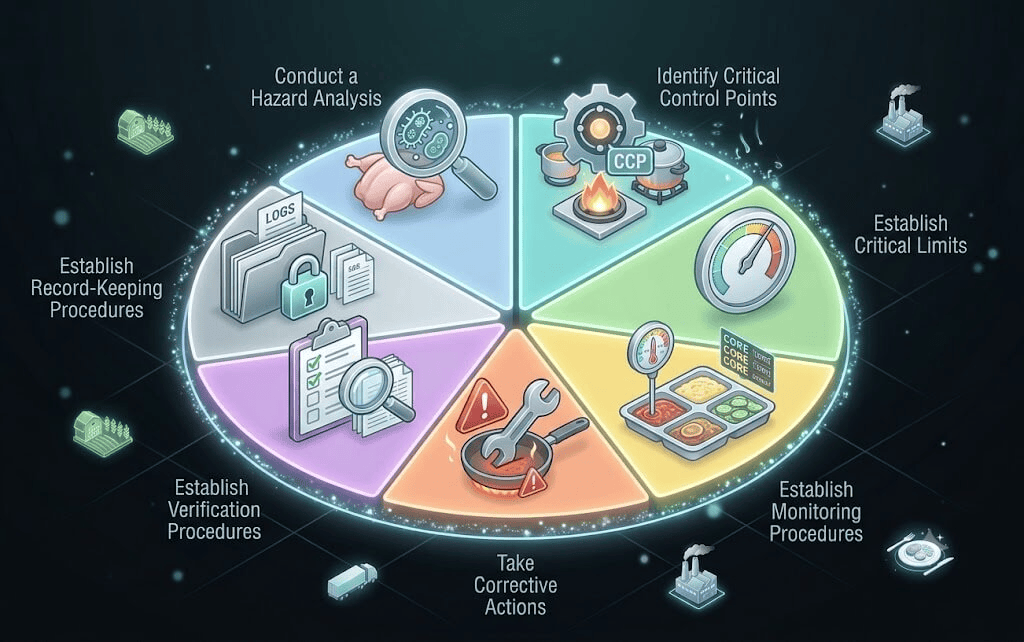
Used together, these seven HACCP principles form a continuous cycle rather than a one-time process. Businesses should regularly review, monitor, and update their HACCP plan as operations, suppliers, equipment, and menus change to ensure food safety standards remain effective and compliant.
Why HACCP Matters: The Importance of HACCP Guidelines
So why are the HACCP guidelines so important, other than a legal box to be ticked?
First and most obviously, it helps to keep people safe. Food poisoning is no remote possibility but a constant threat which can cause a miserable few days or even lead to serious illness and sometimes death – especially for children, people aged over 60, pregnant women and those with compromised immune systems.
Secondly, it safeguards businesses. With a robust HACCP system, you can have an evidence trail. The question “How do you know your cooked meat is safe?” posed by an environmental health officer when they visit might not get a good response from “Usually just check by eye”. “Here is our temperature log, our critical limits and our corrective action record for last Tuesday when the probe thermometer indicated an issue” is a much stronger answer.
Thirdly, it creates a level of trust with customers, suppliers and retailers. The HACCP principles form the basis of almost all food safety third-party recognised certifications demanded by many food retailers and supermarkets in the UK. If there is no credible system in place, the smaller producers may be totally excluded from the larger ones.
Is HACCP a Legal Requirement in the UK?
Yes. In the UK, food businesses must have food safety management procedures based on HACCP principles. This applies to restaurants, cafés, takeaways, mobile food businesses, caterers, school kitchens and many home-based food businesses.
However, the system should be proportionate. A small café does not need the same level of documentation as a large meat processing plant. Smaller businesses may use Food Standards Agency resources such as Safer Food Better Business, while larger or higher-risk operations may need a more detailed, site-specific HACCP plan.
A HACCP plan also needs to be used in practice. A written folder is not enough if staff do not follow the controls, complete checks, record problems, or take corrective action when something goes wrong.
HACCP also connects closely with your food hygiene rating. During an inspection, officers look at how food is handled, the physical condition of the premises and how food safety is managed. A HACCP-based system that is followed, reviewed and recorded properly can help show that the business manages food safety responsibly.
It is also important to note that HACCP is not a standalone system, but rather it operates within the broader legal system. Food businesses in the UK are also under overall food hygiene legislation, which relates to staff training, premises and allergen labelling. HACCP principles are in addition to these requirements and are not an alternative to them. HACCP is the system that deals with your particular hazard, and the general food hygiene law is the basic hygiene standard that all food producers need to adhere to.
The need is even greater in some larger or riskier operations, like meat processing plants. Often, these businesses must have their premises approved as per additional regulations, and they must have a fully documented and customised HACCP plan, not a generic one. If you’re looking to grow from a small kitchen to a larger-scale production setup, it’s best to check early on if your current system is sufficient or if the modifications needed to comply with the regulations are going to be disruptive.
HACCP vs General Food Hygiene Training: What's the Difference?
| Aspect | Food Hygiene Training | HACCP Training |
|---|---|---|
| Focus | Personal cleanliness, cross-contamination prevention, pest control, and safe food handling practices. | Mapping food processes, identifying hazards, establishing Critical Control Points (CCPs), and setting critical limits. |
| Typical Audience | All food handlers and kitchen staff. | Managers, supervisors, and food business owners. |
| Outcome | Promotes safe individual food handling practices. | Creates a documented and effective food safety management system. |
Both are essential for maintaining high food safety standards. Good personal hygiene and food handling practices help prevent contamination, while a well-designed HACCP system identifies and controls food safety hazards throughout the production process. Together, they provide a comprehensive approach to protecting customers and meeting legal food safety requirements.
A Real-World Scenario: HACCP in Action
Suppose it’s a little independent café that’s making a chicken and bacon salad for lunch.
They consider raw chicken to be a high-risk food. The critical control point for chicken is its safe cooking temperature before the chicken is removed from the heat and combined with the salad. Staff monitor this using a calibrated probe thermometer and record the temperature.
One afternoon, a probe reading is received that is lower than one would expect. The team has a corrective action plan agreed upon, so they do not rely on guesswork; the batch goes back on the heat, is rechecked, and then it goes out when it’s right. The incident is recorded. No person becomes ill, no awkward conversation with a customer occurs, and there is a written record that the system detected the problem.
That’s what HACCP is supposed to be doing! simple, practical and effective.
Common Misconceptions About HACCP
A few myths tend to circulate, especially among people new to the industry:
- “HACCP is just extra paperwork.” In reality, the documentation exists to support a thinking process, not replace it. Paperwork without genuine monitoring behind it offers no real protection.
- “Only large factories need it.” Every UK food business needs HACCP-based procedures, though the complexity scales with the size and risk level of the operation.
- “Once it’s written, the job is done.” A HACCP plan that hasn’t been reviewed since the business opened is almost guaranteed to be out of date. New suppliers, new menu items, or even a change in kitchen layout can shift where your risks actually sit.
- “It’s the head chef’s responsibility alone.” While one person usually holds overall food safety authority, an effective system depends on every team member understanding their part in it, from the person taking deliveries to the one plating up.
Getting Started With Your Own HACCP System
Whether you’re installing a food business or upgrading to an up-to-date system, a smart place to begin is the Food Standards Agency’s complimentary resources, which are particularly designed for UK-based food businesses and customisable to a number of sectors, from catering to small manufacturing.
Then, review your own process carefully and honestly. Never copy a template verbatim; your kitchen is different, your suppliers are different, and your hazards are different. Get your team on board as well: they may be the first to notice a hazard, and they can assist with the cleanup after the incident.
Plus, it’s important to establish a review cadence from the start, not as an add-on. Even a brief monthly review (ten minutes) asking, “Has anything changed in the way we are doing things that might impact our hazards?” can help identify issues before they grow into a major problem. It helps if many of the small business owners make this review a habit, such as reviewing stock at the end of each week or at a staff meeting, so that it does not become yet another chore that is simply overlooked during a busy week.
Last but not least, don’t hesitate to seek assistance. Environmental health teams from local authorities are sometimes a more accessible option than business owners think, and many are willing to provide informally requested advice and guidance to businesses that are genuinely trying to do the right thing, not just showing up to impose penalties once the problems have occurred.
Conclusion
The principle of HACCP food safety is not a matter of compliance with an inspector or a food safety audit. It’s a systematic approach to repeating the question, “What could go wrong here and how do we prevent that?” This attitude, when consistently applied, is what keeps people safe.
Knowing the HACCP meaning is more important than knowing what all the paperwork entails, especially when opening your first café or when you are revisiting your procedures at your existing café.
FAQ:
HACCP stands for Hazard Analysis and Critical Control Points. It is a preventive food safety management system that identifies, evaluates, and controls biological, chemical, and physical hazards throughout the food production process.
HACCP helps food businesses prevent contamination before it occurs, reducing the risk of foodborne illness. In the UK, most food businesses are legally required to implement food safety procedures based on HACCP principles.
Yes. Under retained UK food hygiene legislation, food businesses must have food safety management procedures based on HACCP principles. The exact requirements vary depending on the size and nature of the business, but all food businesses must manage food safety risks effectively.
A Critical Control Point (CCP) is a stage in the food process where a hazard can be prevented, eliminated, or reduced to an acceptable level. Examples include cooking, chilling, or reheating food.
Critical limits are measurable safety standards that must be met at each CCP, such as minimum cooking temperatures, refrigeration temperatures, or cooking times.
Trending Posts
Learn smarter, grow faster
Explore our blogs and take your skills to the next level.


Course Categories
- Accounting & Finance
- Animal Care
- Beauty & Wellness
- Business
- Business & Management
- Career Bundles
- Employability
- English Language / Adult Education
- Finance
- Health & Fitness
- Healthcare, Safety & Fitness
- Hospitality
- HR and Leadership
- interactive course
- IT & Development
- IT, Software & Technology
- Job Ready Programme
- Language
- Lifestyle
- Management
- Marketing
- Personal Development
- Photography & Video
- Project Management
- Psychology
- Security
- Sports
- Teaching & Education
- Technology
- Therapy
- Web Development