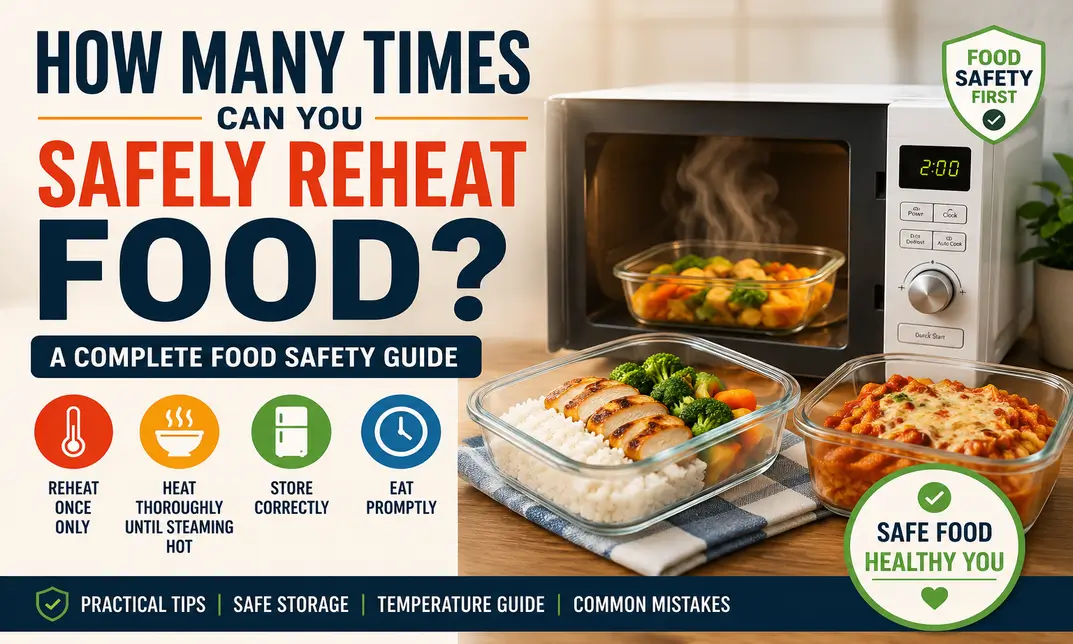
Reheating leftovers is one of the easiest ways to save time, reduce food waste and turn yesterday’s dinner into today’s lunch. But there is an important food safety question behind that convenience: how many times can you safely reheat food?
The short answer is simple: in the UK, the safest approach is to reheat leftovers only once. Food should be stored correctly, reheated thoroughly until steaming hot throughout, and eaten promptly afterwards. This is particularly important for foods such as cooked chicken, rice, and takeaway meals, where poor storage or uneven reheating can increase the risk of food poisoning.
This guide explains the science behind reheating food, answers common questions such as “Can you reheat chicken?” and “Can I reheat rice?” and “Should I reheat food to what temperature?”, and gives you practical steps for safely handling leftovers at home.
How Many Times Can You Safely Reheat Food?
The safest rule is to reheat cooked food only once. Every time food moves from hot to cool and back to hot, there is another opportunity for bacteria to multiply if storage, cooling or reheating is poorly controlled.
The Food Standards Agency (FSA) advises that leftovers should only be reheated once and should be steaming hot throughout. The reason is not simply that repeated heating makes food less tasty. The bigger issue is what happens during the cooling and storage stages between reheating cycles.
For example, imagine you cook a large chicken casserole on Monday evening. You refrigerate it properly and reheat one portion for Tuesday’s lunch. Rather than reheating the entire casserole again on Wednesday, divide the original meal into individual portions before storing it. You can then heat only what you intend to eat.
This simple habit reduces unnecessary temperature changes and also helps preserve the texture and flavour of the meal.
Why Can Reheating Food Become Unsafe?
Cooking kills many harmful bacteria, but food does not automatically remain safe forever after it has been cooked. If cooked food is cooled too slowly, left at room temperature for too long or stored incorrectly, bacteria can multiply.
This is why food safety is about more than simply turning up the microwave. Reheating can kill many bacteria that may have grown, but some bacteria can produce toxins that are not reliably removed by reheating. Rice is a particularly important example because Bacillus cereus spores can survive cooking and become a problem if cooked rice is handled incorrectly.
The FSA describes a temperature range in which bacteria can grow as the “Danger Zone”. Its current consumer guidance identifies 8°C to 63°C as the range where bacteria may grow, which is why leftovers should not simply be warmed gently and left sitting around.
The safest approach is therefore to control the entire process: cook properly, cool promptly, refrigerate or freeze correctly, and reheat thoroughly.
Reheat Food to What Temperature?
A common question is: reheat food to what temperature?
For home cooking in the UK, the FSA’s consumer advice focuses on reheating food until it is steaming hot throughout, rather than providing one universal household reheating temperature for every meal. For home reheating, the FSA advises heating leftovers until they are steaming hot throughout. If you use a food thermometer, 70°C for 2 minutes is one of the FSA’s recognised time-and-temperature combinations for cooking food. Food businesses may use different validated reheating procedures, including a 75°C target.
Food businesses commonly work with a core temperature of 75°C for reheating, but household cooking should always follow the food manufacturer’s instructions where available.
The important practical lesson is that the centre of the food matters. A plate can feel very hot around the edges while remaining cool in the middle, particularly when using a microwave.
How to Reheat Food Safely
Safe reheating starts before you switch on the microwave or oven. Leftovers should have been cooled and stored safely in the first place.
The FSA recommends putting leftovers in the fridge or freezer within two hours. Current FSA guidance says refrigerated leftovers should generally be eaten within 48 hours or frozen if they will not be eaten within that period. Rice requires more careful handling and should be refrigerated within one hour and eaten within 24 hours.
When reheating, follow the manufacturer’s instructions where applicable. In a microwave, stir the food during heating because microwaves can create hot and cold areas. For thicker dishes, smaller portions can help the centre heat more evenly.
A practical home routine is:
- Cool quickly: Divide large amounts into smaller portions so they cool faster.
- Store correctly: Keep leftovers covered in the fridge and follow appropriate storage times.
- Reheat once: Heat only the portion you intend to eat.
- Heat thoroughly: Make sure the centre is steaming hot, not merely warm.
- Serve promptly: Eat the reheated food rather than allowing it to sit around and cool again.
Can You Reheat Chicken?
Yes, can you reheat chicken. Properly stored cooked chicken can be reheated safely, provided it has been handled correctly and is reheated thoroughly.
Chicken is particularly important from a food safety perspective because raw poultry can carry bacteria such as Campylobacter and Salmonella. Proper cooking and careful handling are therefore essential from the beginning. The FSA recommends that poultry is cooked thoroughly rather than being served pink or undercooked.
If you have leftover roast chicken from Sunday lunch, for example, remove the meat from the bones if appropriate, place it in a suitable container, cool it promptly and refrigerate it. When you are ready to eat it, reheat only the amount required and make sure the thickest pieces are steaming hot throughout.
Can You Reheat Cooked Chicken More Than Once?
The answer to can you reheat cooked chicken is slightly different from asking whether it is physically possible. Technically, chicken can be heated repeatedly, but UK food safety guidance recommends reheating cooked food only once.
Repeated reheating means repeated cooling and heating cycles. If the food spends too much time at temperatures that allow bacterial growth, the risk increases. It can also make chicken increasingly dry, tough and unpleasant to eat.
A better strategy is portion control. If you have a large amount of cooked chicken, divide it before refrigeration. Then you only need to reheat the portion required for each meal.


Is It Safe to Reheat Chicken?
So, is it safe to reheat chicken? Yes, when the chicken has been cooked, cooled, stored and reheated correctly.
The biggest mistake is assuming that reheating can rescue chicken that has already been stored badly. It cannot necessarily do so. If cooked chicken has been left out for too long or has been handled improperly, heating it again is not a guaranteed way to make it safe.
The FSA specifically recommends reheating leftovers until steaming hot throughout and only reheating them once. This principle applies to chicken as well as other cooked foods.
Can I Reheat Rice?
The question can I reheat rice deserves special attention because rice has a different food safety risk from many ordinary leftovers.
Uncooked rice can contain spores of Bacillus cereus. Cooking may kill the bacteria but does not necessarily destroy the spores. If cooked rice is subsequently left at room temperature, the spores can develop into bacteria that multiply and may produce toxins. Importantly, reheating does not reliably remove these toxins.
This does not mean rice can never be reheated. It means the storage process must be tightly controlled.
If you cook rice and know you will not eat it immediately, cool it rapidly, ideally within one hour, place it in the fridge and use it within 24 hours. When reheating, make sure it is steaming hot throughout and do not reheat it more than once.
Reheating Rice in Microwave: Is It Safe?
Reheating rice in a microwave can be convenient, but the microwave itself does not make improperly stored rice safe.
The important point is what happened to the rice before it entered the microwave. If rice has been sitting on the kitchen counter for several hours, reheating it later is not a safe recovery method.
For properly chilled rice, place the required portion in a microwave-safe container and heat it according to the appliance or recipe instructions. Stir during heating where practical, because microwaves can create cold spots. Check that the rice is steaming hot throughout before serving.
Do not repeatedly microwave the same container of rice throughout the day. Heat the amount you actually intend to eat.
Can You Reheat Rice From Frozen?
Reheat rice from frozen safely by following the instructions for the particular food where available. If you have frozen homemade rice, safe defrosting and reheating are essential.
The NHS advises that frozen foods should be thoroughly defrosted before reheating, with the safest method generally being defrosting in the refrigerator or using the microwave’s defrost setting. For rice, however, the NHS specifically stresses rapid cooling and prompt refrigeration or freezing after cooking.
Once frozen rice has been properly defrosted and reheated, eat it rather than cooling and reheating it again. Avoid treating frozen rice as though freezing resets the reheating count.
Can You Reheat Takeaway Rice?
One of the most searched questions is can you reheat takeaway rice? This requires extra caution.
The difficulty is that you may not know exactly how the restaurant prepared, cooled, stored or reheated the rice before you bought it. Some food businesses may precook rice and then reheat it before serving. That means the takeaway rice could potentially have already undergone a reheating process before reaching your kitchen.
Food Standards Scotland advises taking particular care with takeaway rice and says that if you are unsure how the rice was prepared, stored or handled, it is best not to reheat it. If you want to keep it, ask the food business about its preparation and storage practices.
For takeaway rice, eating it immediately after purchase is the safest and simplest option.
Reheating Pizza: What Should You Know?
Reheating pizza is generally straightforward when the pizza has been stored correctly.
If you have leftover pizza, refrigerate it promptly rather than leaving it on the kitchen counter for a prolonged period. When reheating, an oven, hob, or suitable air fryer can help restore the texture better than repeatedly microwaving it.
The safety principle remains the same regardless of the method: reheat only once and make sure the food is thoroughly hot throughout. A crispy crust does not necessarily mean the centre is hot, so pay attention to the toppings and thickest parts.
If the pizza has been left at room temperature for too long, however, reheating should not be viewed as a way to “reset” its safety.
Is Microwave Reheating Safe?
Microwaves are perfectly useful for reheating food, but they require a little more attention than simply pressing a button.
The FSA notes that microwaves can leave the edges hot while the centre remains cold. Stirring during heating can help distribute heat more evenly. For thicker foods such as casseroles, curries and pasta dishes, dividing food into smaller portions can also improve reheating consistency.
Avoid relying solely on a timer. A one-minute or two-minute routine may not be enough for every portion because food quantity, shape, starting temperature and microwave power all affect the result.
Instead, check the centre and make sure the entire portion is steaming hot before eating.
What Happens If You Reheat Food Twice?
Reheating food twice is not recommended, even if the food still looks and smells normal.
Every additional cycle creates another opportunity for poor cooling, prolonged storage or incomplete reheating. The FSA’s current guidance therefore recommends reheating leftovers only once.
There is also a quality issue. Repeated heating can cause meat to become tougher, rice to become dry or sticky, vegetables to lose their texture and sauces to separate. So the safer approach is also usually the better approach for taste.
Foods That Need Extra Care
Rice is one of the clearest examples, but it is not the only food that deserves attention. Cooked meats, poultry, pasta dishes, casseroles and meals containing eggs should all be stored and reheated carefully.
The ingredient itself is only part of the equation. A chicken curry that was cooled rapidly and refrigerated correctly is very different from the same curry left on a dining table for several hours.
This is why food safety professionals focus on the complete chain of handling rather than asking whether one particular food is automatically “safe” or “unsafe” to reheat.
Common Reheating Mistakes to Avoid
Many reheating problems happen because people focus on temperature while forgetting storage. A meal that reaches a high temperature after being stored incorrectly may still present a food safety concern.
The most common mistakes include reheating an entire container when only one portion is required, leaving leftovers at room temperature for too long, relying on microwave time alone, failing to stir thick foods and reheating the same food repeatedly.
Another common mistake is judging safety by smell or appearance. Food can look perfectly normal and still contain harmful microorganisms. When in doubt about how food was stored or handled, throwing it away is safer than trying to rescue it through additional heating.
A Practical Reheating Routine for Busy Households
Imagine you have cooked a large batch of chilli on Sunday. Once the meal is finished, you divide the leftovers into smaller containers and cool them promptly before refrigerating them.
On Monday, you take out one container and reheat that portion until it is steaming hot throughout. You eat it immediately and do not put the partly eaten portion back into the fridge for another reheating cycle.
This approach is simple, economical and realistic for busy households. It also makes portion control much easier and reduces the temptation to repeatedly warm the same leftovers.
Conclusion
Reheating leftovers does not have to be complicated. The safest habit is to think beyond the reheating stage itself.
Cool food promptly, refrigerate or freeze it correctly, keep an eye on storage times, reheat only the portion you need and make sure the food is steaming hot throughout. Most importantly, reheat cooked food only once.
Rice deserves particular attention because incorrect storage can allow Bacillus cereus to multiply and produce toxins that reheating may not remove. Takeaway rice also deserves extra caution because you may not know how it was prepared before purchase.
If you are ever unsure whether a leftover meal has been stored safely, do not rely on smell, appearance or another round in the microwave. When the storage history is uncertain, discarding the food is the safer decision.
Good reheating habits are ultimately about simple temperature control, sensible storage and avoiding unnecessary reheating cycles. Follow those principles and leftovers can remain a convenient, economical part of everyday meals without compromising food safety.
FAQ:
The safest recommendation is to reheat food only once. The FSA advises that leftovers should be reheated thoroughly until steaming hot throughout.
Yes. Properly stored cooked chicken can be reheated once. Make sure it is steaming hot throughout before serving.
Yes, but rice requires extra care. Cool it within one hour, refrigerate it promptly, eat refrigerated rice within 24 hours and reheat it only once.
It is safest to eat takeaway rice immediately because you may not know whether it has already been precooked and reheated. If you are unsure about its handling, do not reheat it.
It can be, provided the rice was safely cooled and stored first. Reheat it thoroughly, stir where appropriate and ensure it is steaming hot throughout.
Properly frozen rice can be reheated following safe defrosting and reheating practices. Do not repeatedly cool and reheat it after it has been defrosted.
For UK home cooking, the FSA advises reheating food until it is steaming hot throughout. The FSA also publishes safe time-and-temperature combinations, including 70°C for two minutes or equivalent, while food businesses commonly use a 75°C reheating target.
Trending Posts
Learn smarter, grow faster
Explore our blogs and take your skills to the next level.


Course Categories
- Accounting & Finance
- Animal Care
- Beauty & Wellness
- Business
- Business & Management
- Career Bundles
- Employability
- English Language / Adult Education
- Finance
- Health & Fitness
- Healthcare, Safety & Fitness
- Hospitality
- HR and Leadership
- interactive course
- IT & Development
- IT, Software & Technology
- Job Ready Programme
- Language
- Lifestyle
- Management
- Marketing
- Personal Development
- Photography & Video
- Project Management
- Psychology
- Security
- Sports
- Teaching & Education
- Technology
- Therapy
- Web Development



0 responses on "How Many Times Can You Safely Reheat Food? A Complete Food Safety Guide"